🚀🐋 Atmospheric Scoop Divers
Kardashev range: 0.8–1.8
Instead of treating Earth only as a launch well, this idea treats the atmosphere as a resource layer. Fast scoop vehicles could dive deep, harvest volatiles, and move them outward for orbital or lunar industry.
Basic Idea
ABEP is an idea for capturing gas in a low Earth orbit (presumed circular) and ejecting it at higher speed to gain momentum. There is punishingly little engineering margin at the speeds involved and if it does work, it's really hard to make it work as a propellant exporter for other missions.
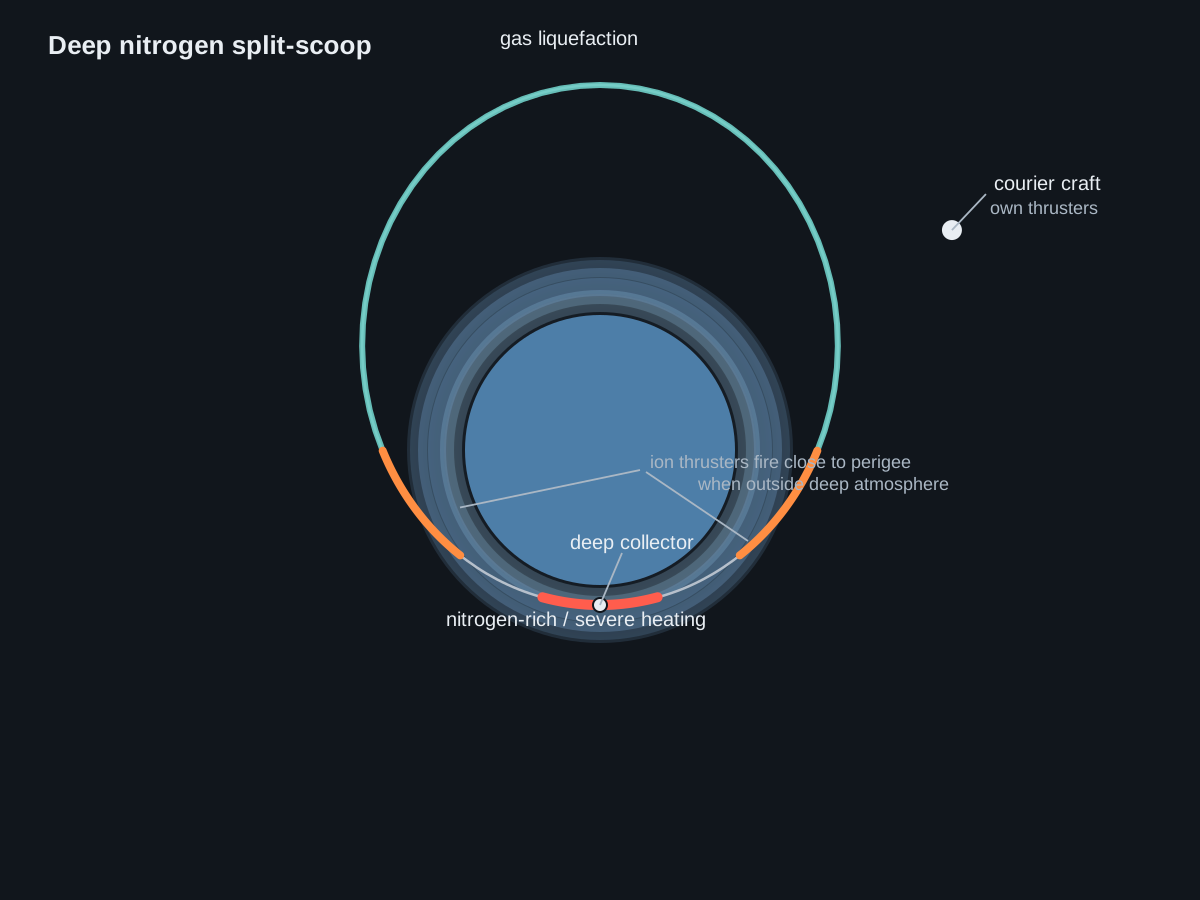
What I am positing instead is that it might work in a non-steady-state way. That means using an elliptical orbit with a regular dive phase into atmosphere, followed by a coast phase back out of it.
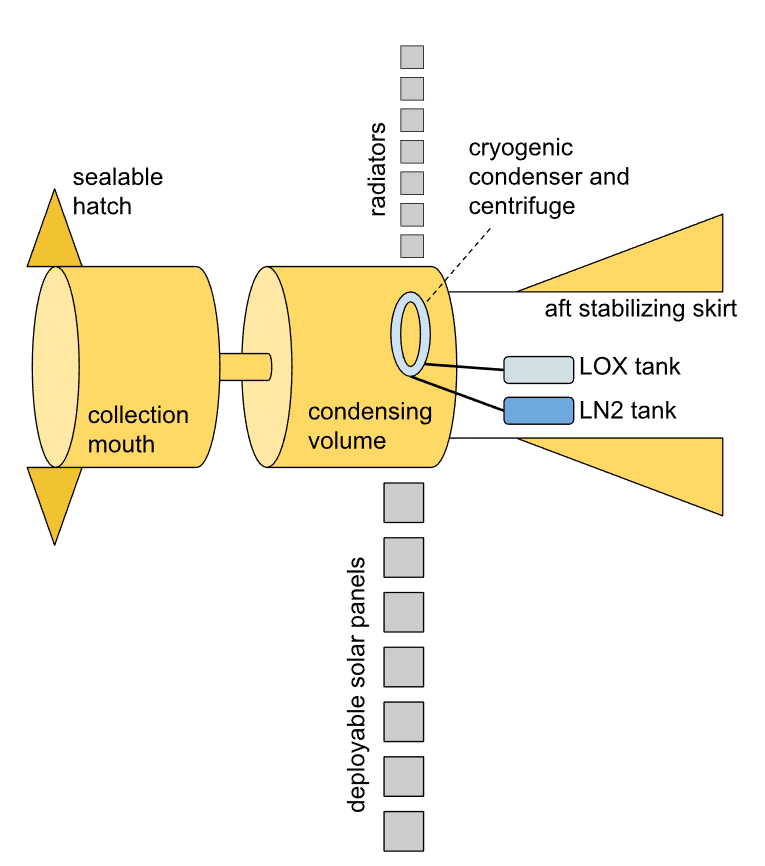
That offers several advantages. One is active cooling, which can be refreshed in the coast phase. You cannot lose any coolant, so the vehicle needs to remain closed until close to perigee, at which point it can open its mouth and let the bow shock keep the new air and the coolant in place.
The upper levels of Earth's atmosphere are mostly molecular oxygen, and that kind of sucks if what you really want is nitrogen. Oxygen is still useful, and in some architectures it could even be the point, but it brings additional handling and storage challenges and does not solve the big atmosphere-fill problem for space habitats.
To get any significant fraction of nitrogen, the diver has to go much lower. That makes the thermal and drag problem substantially worse, but it is the whole reason this concept matters. If you believe in the O'Neill habitat vision, then you have to accept that large amounts of nitrogen will be needed in the cislunar system. The Moon and most asteroids are critically deficient in nitrogen. Mars would be a good source, but Earth is closer.
So the long-term role here is not just “grab some propellant.” These could be nitrogen factories for orbital colonies, with oxygen or propellant products possibly coming along as byproducts. The drawback is a low collection ratio, but if it ran continuously it could still produce net positive mass.
When I was first writing about this, I kept trying to come up with a means of docking at higher orbit. That line of thought resulted in the L1 diamond stabilizer idea. I tried many other ideas for a mothership or for "jousting," but now I think the scoop diver works best on its own, independently.
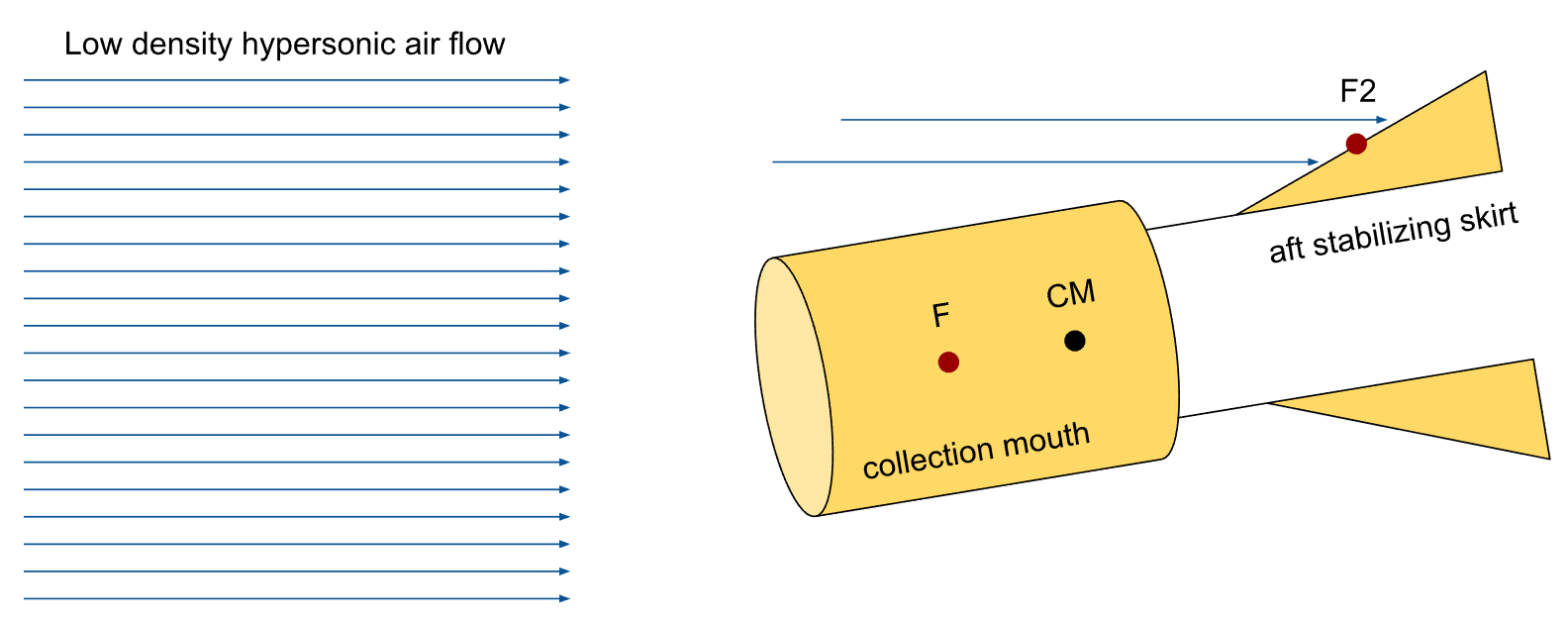
There is some angular weirdness involved in thrusting, but I do not currently think that is the real blocker.
What I don't know
I'm legitimately unsure if this specific form has been described in other papers. I have seen a diagram of collection using elliptical orbits, but they seemed to be incorrectly labeled or else missed something in dissemination.
Also, the basic analysis isn't at all finished. I need to make a calculator for this where the ultimate output is mass return over time.
Finally, the big unknown is materials. Some numbers I can remember looking at (possibly for other variants of this) required about 15x the amount of coolant relative to the amount of gas collected. This means you'll need about 15 passes before doubling that mass, and more for the structural mass payoff. I do think it will be less than this, but even optimistically we would be looking at a dozen passes for payoff. Getting a sense of hypersonic material use with cooling is hard, but Starship might give a good reference very soon!
Links
- L1 diamond and nitrogen factory post - I do not think the writing is very good yet; it is more of a TODO.