🧅🛞 Flow Dividers for Artificial Gravity in Air
Kardashev range: 0.73–1.7
Gravitational Balloon blog is the home of the concept.
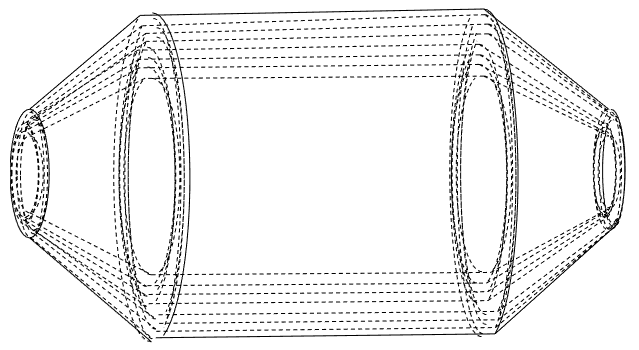
Multiple layers of rotating shells spin all at different speeds, dividing the fluid flow, reducing energy to keep it spinning, enabling artificial gravity modules inside of larger (spherical) pressurized volumes.
Basic Concept
There are multiple rotating wheels that fully envelop each other. Each stage partitions the velocity, dividing the air-flow speed jump on either side of that stage. The counter-intuitive part is that this reduces the overall drag / power consumption / heating. About 17 dividers can allow a 250 meter radius tube to be kept spinning with a motor of reasonable power, considering the number of people who could live inside of it.
The reason this works is because the dividers suppress turbulent flows. The equations we have for drag in these regimes are only approximations because of the chaotic nature of turbulence. You will find that even if you add infinite sheets you will reach an asymptotic minimum of required power, which is the laminar limit - the required power you would have found if you assumed laminar flow. The good news is that reasonable habitat designs are possible well above the laminar limit.
This allows for a space city inside a larger microgravity habitat, with the city sitting inside a globe-like pressure boundary.
But why? Isn't this less space-efficient than a spinning tube in vacuum? That is the conventional O'Neill idea of habitats in space.
The "why" comes largely in the transit argument. Even an extremely large 12 km Island Three habitat would have a population less than a major metro area. The habitat, by itself, does not give a compelling reason for an Earth inhabitant to move there. On the other hand, a space city (with rotation inside the pressure boundary) could have 1 billion people, and put all those billion people within reach of a daily commute. This is a game-changer. Unlike New York or Tokyo, individual space would not be at a premium, because we are not limited in any of the 3 dimensions. Every person could live in large palatial homes while having an economic reach far beyond what cities on Earth could physically offer. And if such a place existed and started to scale, then the attractive force would be irresistible for many, if not most, people.
What I don't know
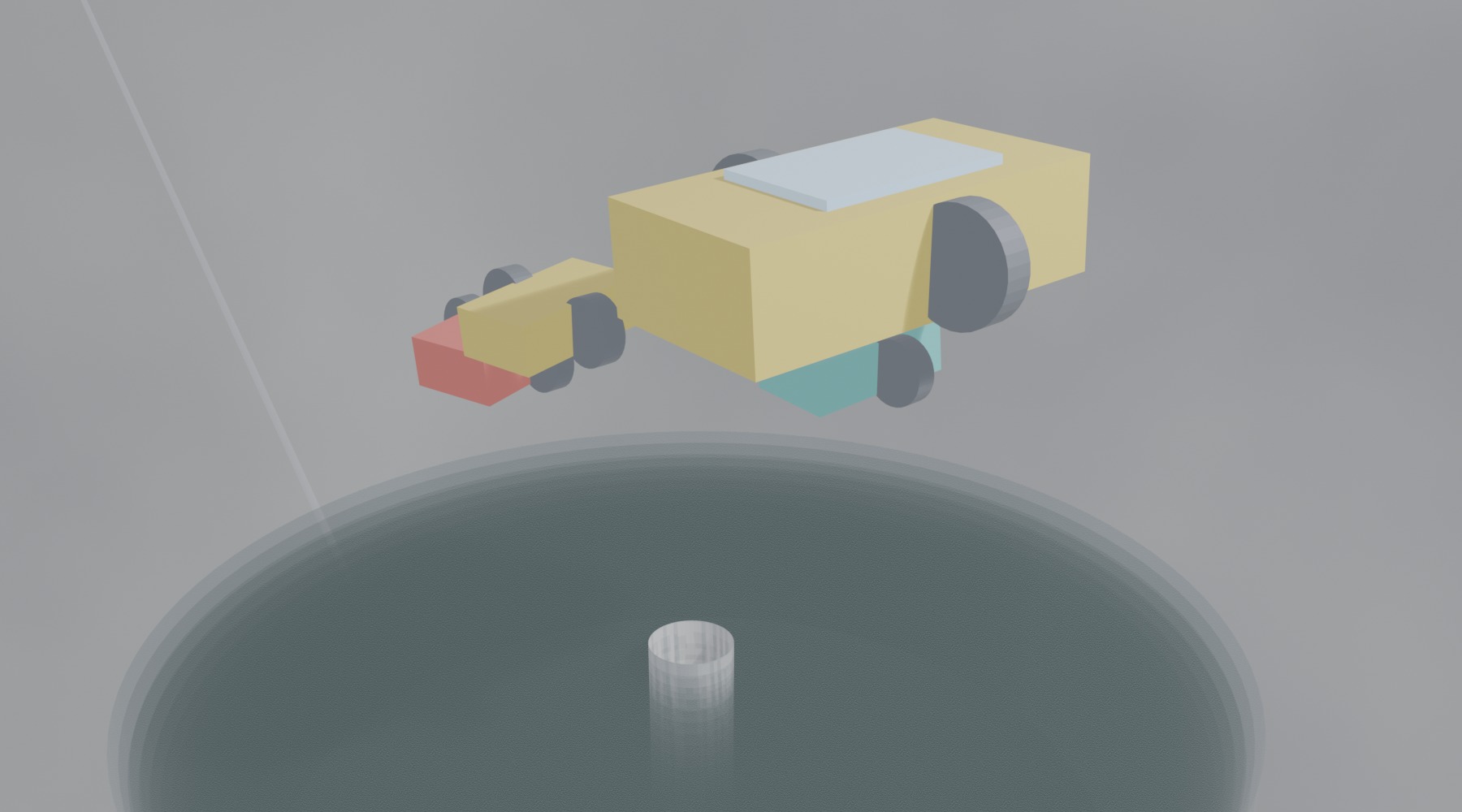
I do not know, practically, how you would stabilize the dividers. However, it remains my strong conviction that this problem is solvable. Simple mechanical wheels can do the job, as a stage-by-stage solution. Alternatively connect-to-hub is another means of holding the dividers in place. I also suspect that either flow directors or active controls could do much better. This is the main place where there is a huge near-term research opportunity with significant benefits for our collective future.
There are also a lot of open options for the tapering around the ends. I find these fascinating, but again, solvable. It gets very esoteric and I've almost certainly lost my audience by that point.
Lately, as I have gotten to experiments, I have favored a more rectangular geometry instead of fancier ones, basically a coke-can shape. However, it is not clear if this is better or worse than distributed wheeled spacers between the dividers.
There is also a whole category of negative-pressure designs where the dividers do not hold pressure at all. Those are radically different, and the stability implications are unclear, which leaves a lot of room for how this idea can evolve.