💎🌕 L1 Diamond Stabilizer
Kardashev range: 0.8–1.8
A diamond-shaped Earth-Moon L1 structure could use internal mass shifting and tidal quadrupole behavior as a stabilization method instead of paying for continual propellant stationkeeping.
Motivation
The diamond stabilizer is a specific form of a concept I dreamed about for years, without being able to put into a form. Talking to AI did help me settle on the geometry, but AI doesn't seem to like to come up with new things on its own. It is always me doing a "what if..." and refining.
The broader idea, which I asked about on Physics Stack Exchange long ago, is that you use a pole like a tightrope walker. If you go off balance, you move the pole to restore your position. This solves a real problem of keeping you centered around an unstable orbit.
I am personally very inspired by Hop's blog. It is the best blog on space tethers that I know of. It did actual novel concept development and doubled down on ideas in ways that pushed understanding of the physical possibilities forward, including things like Jacob's ladders.
However, I am not directly a fan of space elevators. Even a lunar space elevator feels like it is stretching the envelope of believability if we are talking about what might actually get built. It is too long. Hop is great, but space elevators in the simple sense are too fanciful and too long-term for me.
The idea of using tethers for orbital stability squares the circle. Instead of measuring tens of thousands of kilometers, we are talking about hundreds. That is not a small difference, and the operational consequences are much greater than 100x. Building something 100 times as long is not necessarily 100 times as hard, and it is probably harder by a greater factor. And anyway, if we do ever build space elevators, we need to cut our teeth on something smaller.
The diamond stabilizer can effectively act as a momentum source. That means it can have, for example, a mass driver. If launches impart some momentum to the station, who cares? It will stabilize itself, and this does not use consumables. This is the kind of benefit you would have wanted from a space elevator, except you do not need the space-elevator part.
I still have a lot of improvements to make in the simulation to give a better intuitive feel. The numerical models I have are kind of ugly to follow and do not help develop intuition the way they are run.
Basic Idea - Why a diamond?
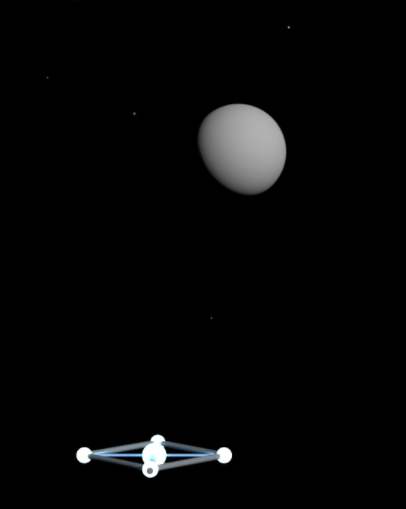
The reason for the diamond shape is that you can squish it to elongate in one direction or the other, in a way where the moment of inertia of the total structure does not change. That means it keeps rotating at the same angular velocity before and after the squish, namely the angular velocity of the Earth-Moon system.
This isolates torsional effects and lets you produce a pure shape change in the rotating frame of reference.
Those shape changes then lead to a very, very tiny acceleration because Earth and Moon have different gravitational-field shapes, mostly because they are different sizes. Exploiting those small accelerations can offset drift from the orbital instability and let you generally move around, within some limits.
More specifically, you would use this to balance the saddle-point instability at Earth-Moon L1 with a basic PID controller. This only balances along the Earth-moon line. The other directions are stable.
What this means in practice...
My initial numbers required a diamond with a side length of about 200 km. Each vertex of the dimond would be a mass. Could be space habitats, could be ballast rocks, it's not important. It is important that these 4 masses must both push and pull against each other - which calls for a tensegrity type structure. Ultimately, winch would move the masses in the diamond (very slowly) in response to trajectory deviations.
The L1 point is also special because it gives fantastic Delta V approaches to all of our most important destinations. The main reason against using it is actually solved by this scheme. The main downside is that it is very large and multi-component. So this is only useful when we are already significantly space-faring, but there's a good argument that it will be useful at that point. It can manage to work its way into many other grand archectures in the cislunar system. Another drawback that I think humans haven't processed yet is that you can only have 1 of these systems at the Earth-Moon L1 point, so we would all have to agree on many governance issues of the system. And we don't have a great track record for these things.
What I don't know
What I do not know is how, or if, you would correct for perturbations in and out of the plane. The diamond could extend in 3 dimensions into a rectangular octahedron. You can draw that shape, but I do not know what the control law for it would look like.
Again, the L1 point is unstable in 1 axis, and the 2 other axes are stable. But you still want to be able to dampen in those 2 directions. So dampening motion in the orbital forward-reverse direction is also a problem, very similar to how in-and-out of plane movement is a problem. You're not stabilizing, you're just dampening... but, how do you do that without messing up control in the other direction? That's actually a quite complex question, but I believe it can probably have a very full and satisfying solution.
Another thing I do not know is the contingency-case story. The L1 location is super useful because it can reach so many other orbits with small initial-condition changes, but that is a double-edged sword because people will worry about it hitting Earth. I do not know generally if I have this correct, and the problem needs a lot more specific color on it.
Links
- L1 diamond and nitrogen factory post - I do not think the writing is very good yet; it is more of a TODO.
- Orbital shape sim on GitHub