🌐🧱 Passive Pressurization via Self-Gravity of Walls
Kardashev range: 1.3–2.4
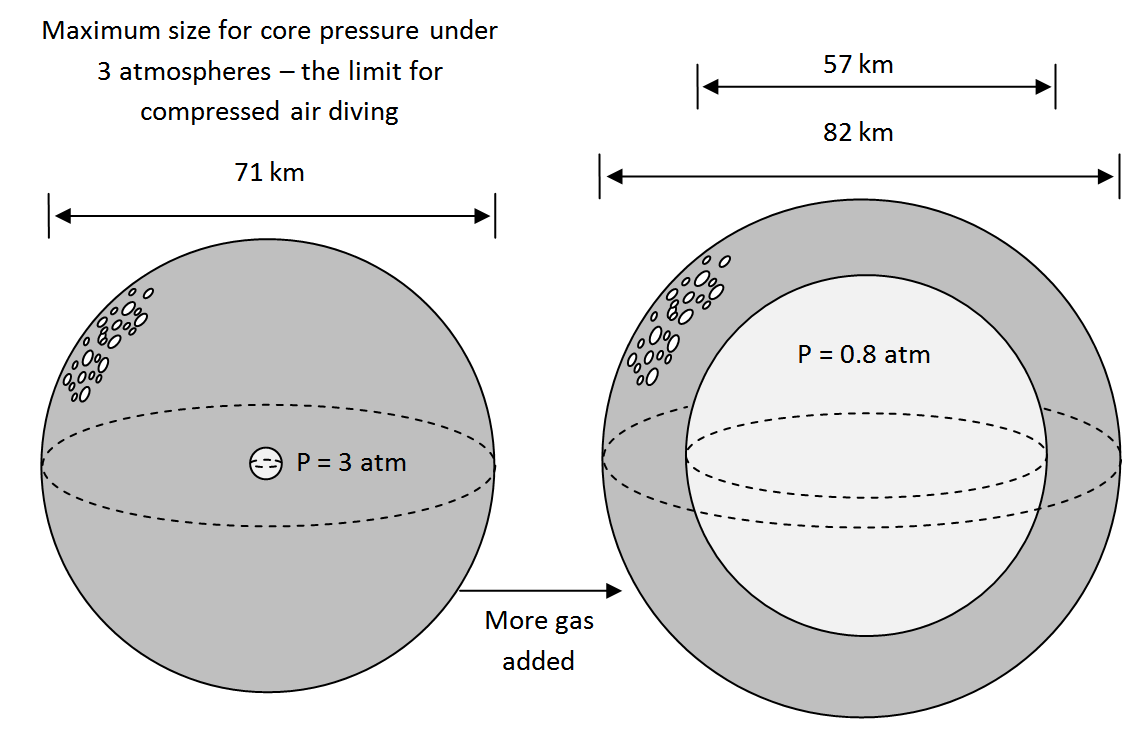
The geometry for this idea is a sphere of air, surrounded by roughly 12 km of asteroid rock. The rock's self-gravitation balances against the outward air pressure, replacing the need for tensile material strength.
Basic Idea
The geometry for this idea is a sphere of air, surrounded by roughly 12 km of asteroid rock. There is a liner around the sphere of air, which is theoretically only a molecular barrier and prevents the obvious leaking and mixing. The rock, like all mass, has gravity, and this gravity pulls on other parts of the wall. The net effect is that the rock's self-gravitation balances against the outward air pressure. This passive pressurization replaces the need for tensile material strength. So provided you have enough mass then you can make extremely large habitat designs, although stability concerns still exist for extremely large sizes.
The challenge of building it is obviously movement of mass into the locations where it is needed, but asteroid macroporosity could give us a good head start on this. We do not have much in the way of specific geometry for asteroid internal voids right now, so we cannot say how usable they are until we explore them.
What I don't know
The exact stability requirement matters and is fully computable. Let me tell you how. (1) you must assume that the liner is fixed. This assumption is not physically problematic as long as you assume there are not holes or any such obvious problems. There is surrounding pressure and the material doesn't "want" to do anything bad there (2) you must give the rock (regolith) some tumbling criteria. This is similar to sand. Yes, treat the rock as if it were sand, and you won't do too bad to simulate asteroid material... generically. Then (3) bang on it in the simulation. Hit it with an asteroid. Squish two sides inward. Drill an access tunnel. Give an offset to the air bubble. For all of these cases, with the tumbling criteria, we can obtain a failure point. This is the point at which the regolith tumbles, and thus is the safety criteria. (leave some engineering margin...)
I am fully capable of doing this, I just have not gotten around to it. I tried many years ago when computers were overall not as capable as they are now and I didn't have that much time to put it in anyway. If I return to the problem this is a key area.
Next, is obviously what the structure of asteroids are in the first place. The first interesting candidate is Phobos, the moon of Mars. How hard is it to get way into the interior an average asteroid? Phobos will probably give us our first answer.